Sunday, January 25, 2015

Take Me Out to the Ballgame. RIP Ernie Banks.


Dear Ernie Banks. 

The news of your death has made me sadder than seems reasonable. I may have been a tomboy growing up but I wasn’t an athlete. The boys never let me play baseball with them in the McLean Avenue cul-de-sac and would yell at me to get lost if I tried to hang out while they traded baseball cards. I don’t think I ever saw you play — unless I saw the Padres play the Cubs when Mike and I went to games in 70 and 71. I would offer to take my brother to a game and Mike would walk down to the stadium to meet us. Such romance!

But now that I think about it, I realize that you kind of were part of my growing up. Your career with the Cubs started the year I was born in Chicago, and ended the year I graduated from high school. We left Chicago for Los Angeles and then San Diego, and my brothers eventually became Dodger fans, though I know that Mark always tries to go to a Cubs game when he’s in Chicago. And always, I know that your name and career were part of baseball conversations. I’m pretty sure even the very old, very racist Chicago uncles respected you. I never got to participate in sports discussions — in that tiny Chicago apartment we were forced to visit, or when I tried so hard to hang out with the boys — but I listened.

Wrigley Field. 2012.
I was born in Chicago and visited many times.
It took me 59 years to actually get inside Wrigley Field. 
There are plenty of other people who played baseball during my lifetime and I’ll mark their passing when they die too. But I can’t think of one like you, who even on a lousy day might say “It’s a beautiful day for baseball! Let’s play two!” As Michael Wilbon said  “I guess childhood officially is over now that Ernie Banks has left us.” Maybe that’s why the news of your death got to me.

I don’t have a flair for baseball stats so I’ll let everyone else talk about your amazing stats. I don’t get to very many games anymore and there have been years, maybe even decades when I haven’t attended even one game, so there are way bigger and better fans than I. They have plenty to say about you too. So many are saying “Let’s play two” in your honor. I love that idea. This former tomboy longs for the days when she spent her days outside playing until the streetlights came on.

Thinking of you reminds this former tomboy how much she loves baseball. I’m pretty sure it’s because of players like you. Thanks for that.

Rest in Peace Mr. Banks. Or should I say Mr. Cub? 
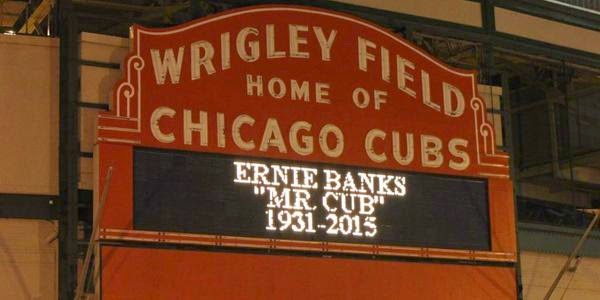
The Wrigley Field sign. January 2015

Thursday, December 4, 2014

Rubber Soul.

My husband posts a daily, local weather report on Facebook, usually with a “this day in history” note. Today he noted the 49th anniversary of “Rubber Soul” and asked what’s your favorite cut. I couldn’t answer because I’ve never been able to choose a favorite cut or even a favorite Beatle. But this album was life changing for me and I’m grateful that my mother gave it to me for Christmas in 1965. 

Just before school started that September, we moved from L.A. to La Jolla (near San Diego.) The adjustment to our new lives was not going well. My mother had her own adjustments to make and I don’t know how she found it in herself to care about our needs. We were all pretty miserable. Then on top of the misery, most of us were sick with the flu that Christmas.

I was allowed to go see the Beatles at the Hollywood Bowl just before we moved so everyone knew I was a “Beatlemaniac.” But my brother teased me incessantly about it, as he did about everything, and so I didn’t talk much about the Beatles. I listened to the radio by myself in my room, with the volume as low as I could get it and still be able to hear it! I never had to wait too long to hear a Beatle song. We weren’t a family who bought albums of any kind, much less Beatles albums! Oh, we had a record player, but very few records and none of them were rock’n’roll records.! I had only purchased one 45 record! 

So when I opened that gift and saw the album cover, I was shocked. I remember looking over at my mother to thank her and she just looked at me and sort of nodded her head and gave me fleeting smile. After all the wrapping paper had been cleared away most of us were too sick to do anything beyond sprawl around on the sofas or floor. I put the record on the turntable and lay down on the floor with my ear up against the speaker so I could keep the volume low. I didn’t want to bother anyone, sure, but mostly I didn’t want to share my first listen with everyone in the room. I felt transported to my own little world where no one could reach me or bother me or tease me. 

Now, my mother always supported all of us in our interests so this wasn’t really a first. But it felt significant. And so in my memory, the magic of my first listen to Rubber Soul will always be associated with my mother’s fleeting smile of acknowledgement and the feeling that she understood who I was at that moment in time. Or maybe she didn’t understand me at all, but simply walked into the record store and asked for the most recent Beatles album! That’s OK too.


“Though I know I'll never lose affection 

For people and things that went before, 
I know I'll often stop and think about them 
In my life I love you more.”
In My Life  (Lennon-McCartney) From Rubber Soul 

Monday, November 17, 2014

Motherless Daughters (and Sons)

My mother with me.
I’ve been thinking a lot lately about some friends who became motherless daughters in recent months and about how I’ve now lived long enough that I know way too many motherless daughters and sons. Of these recent members of this club, one is younger than me. Her mother, who was probably near my own age, died suddenly, and from my friend’s perspective, way too young. My friend is angry and is waiting for some sort of “sign” or for her mother to appear in her dreams. Other new members are my age (or nearly) and lost mothers who were in their 80’s. Then there’s the members whose mothers died when they were just kids themselves. Other mothers died when their daughters were just becoming women themselves. And finally what about the members who never knew their mother because she died before they had a chance to know her, or because another mother adopted and raised her? 

All of these daughters have a story to tell. I am sure that I am extra sensitive to them right now as I enter the world of the grandmother. I just wish there was something I could say or do to help these newest members of the club. But I know they all have to find their own way through their grief. I know things that they don’t know yet and I wish I could be there for them at just the right moment to say “Yes, that is a real feeling you are having. Go ahead and feel it.” I know that grief can sometimes look and feel like anger. I know that sometimes grief eases up and then comes back for a second, third, fourth, tenth, fiftieth attack — usually at just wrong moment. I know that you never “get over” your grief; you only learn to control it or maybe if you’re lucky you figure out a way to do something useful with it. 

I know that even if your mother-daughter relationship was not all rose-colored; even if there were times you referred to her as “The Bitch” and could hardly wait to get out of that crazy house; even if you had a really unhealthy co-dependent relationship; or if you view her as a saint who was flawless: I know that becoming a motherless daughter or son is a defining event in our lives. 

In 1994, I read a book called “Motherless Daughters” by Hope Edelman (http://hopeedelman.com), and I gave copies of it to people I knew who were already motherless daughters. I felt confident that it prepared me for the eventual day when I became a motherless daughter. Of course I didn’t expect that to happen for a long time and didn’t know I’d become a fatherless daughter first. At the time, I was the mother of three daughters myself and had a decent relationship with the former “Bitch” now that I understood what she was going through during the years I referred to her so fondly. She was a wonderful and loving, though strict, grandmother. 
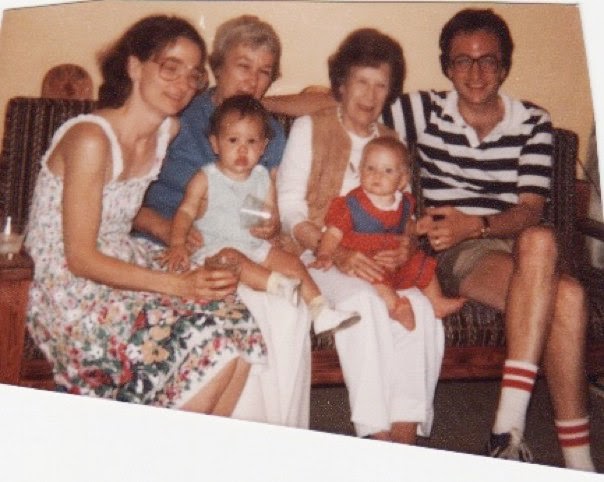
My brother and I with our mom, grandmother,
 and the first grandchildren.
When my father died in 1998, she already had her first broken hip and within a few years had her second hip surgery. As if my father’s death wasn’t enough, my sister died two years later. Her grief really sucked the wind out of her sails. Then my mother was sidelined by triple by-pass surgery while visiting me, and a few years after that, by pulmonary embolism; and she finally moved into an assisted living home where she died in 2009. I’m not even sure how many times I flew back and forth across the country to do what I could to help. She had so many ups and downs and more than once reached a point where she would have chosen death. In fact, after the pulmonary embolism, she refused treatment and went home under hospice care. I suppose her heart was working too well because she survived, just as she had before.

Every time I left her, I felt like I was saying my final goodbye. Once, as my daughter and I stood at the door to leave and called out our traditional parting words, “See you tomorrow!” she waved weakly and said “In your dreams.” 
My mother with her first-born granddaughters, 
at the rehab center before going home.
When I was leaving to return home after the triple bypass surgery (I had flown with her across the country after her months in rehab here) I laid down next to her on her bed and told her thanks for letting me help her get through the awful experience and thanks for being my mother. She hated it and recoiled when anyone said nice words about her. She raised her hand to shut me up and said “Stop.” A few years later, I stayed with her after the pulmonary embolism. When it became clear she no longer needed hospice care, she was pretty angry about surviving and about having caregivers. I knew she was ready to check out but her heart was working too well, thanks to the bypass surgery. However, my tour of duty was over and so I packed up, said “See you tomorrow” and went home. I felt sure I’d never see her again.


But she rallied and we had a few more visits. Then five months before she died in the assisted living home (where I had helped move her on one of my visits) I sat in the incredible leather chair my brother had purchased for her and took a nap while she napped. When she woke up, I showed her my web site about her and my father during World War II. I read my dedication page to her, and I cried. She put her hand up and though she could hardly speak, told me to “Stop.” I sat on the edge of the bed and explained that I wouldn’t be able to get back for a visit for a few months — hoping that she’d get my message that I knew this was my final goodbye. I knew she was fading away and was ready to go, but I needed to tell her one more time that I loved her. I sat there for a long while, giving her updates on every member of the family. She was asleep when I finally got up to leave. That is my final image of her.

There is so much more I could write and I suppose I will eventually. It’s taken me five years to write this much. And I guess that’s what I wish I could express to my friends. Take whatever time you need! Get some therapy if you need it for your grief and anger, especially if you find that your reactions to everyday life are out of proportion to the activity around you. My anger after my father’s death nearly ruined me. Don’t worry about what you imagine others think of you as you experience your grief, but do worry (and get help) if you find that you are reacting inappropriately to people. Don’t worry if she doesn’t appear in your dreams. In fact, don’t have any expectations. There are no rules about grief—only the unrealistic expectations we put on ourselves.

In the five years since my mother died, I’ve done many things to remember her. I’ve re-built my World War II web site, which means I live with her in my thoughts every day. I work on the family genealogy on a weekly basis, which is of course, more time spent with her. Now that I'm a grandmother, I think of how generous she was with her time and love for me and my babies, and all of her grandchildren.

My friend whose mother died recently and suddenly, hopes for “a sign” from her mother. I can’t say that I’ve had “signs” from my mother but I have experienced that feeling regarding other loved ones who have died (see http://honeylights.blogspot.com/2014/01/the-story-of-lady-slipper.html) and I learned that it didn’t happen at the times and places I expected or wanted. I think my mother was far too practical for such things as giving me a sign or even for appearing in my dreams — in spite of her prediction when she replied “In your dreams.” She hated it when I cried or got sentimental. She really hated it when someone told her how wonderful she was. If she were to appear to me or give me a sign, I’m pretty sure she would hold up her hand to me and say, “Stop!”
My mother with her four surviving children and spouses,
 and her 12 grandchildren.

Thursday, September 11, 2014

Dreaming My Way to You

Sometimes we just wish we were on the way to visit our mother! Events today made me think about this old card that I sent to my mother one time and came back to me in her purse after she died. 
I remembered that I had seen it in her purse one time and asked her why she carried it around. She said it reminded her of me! That seemed odd at the time because I never imagined her wishing I were there. I only knew that there were so many times in my life that it felt like the only thing that would make me feel better would be if I could be sitting at her table. And after she died, I wished that more and more often.

It’s kind of ridiculous when you think about it, because the reality is that no matter how strong that feeling is, the truth is that as much we love our mothers, they can also drive us crazy! Sometimes they even make us feel worse, with that sharp, well-placed comment about what we’re wearing or our current hairstyle or how we’re raising our kids. Still, when something wonderful or horrible is going on, we want to run and be with them!

Last night I finished reading a book called “Spirit Car” by Diane Wilson in which the author travels through South Dakota, Nebraska, and Minnesota to discover her family’s history. At the end of the book, sitting with her mother, she remembers how her mother always told her that “she travels with us when we’re away. I know that her spirit travels at night, that she dreams her way to wherever her children are, checking that they’re safe, guiding them home again.”

I really never thought of myself in this way before but today I realized it’s true. I do dream my way to wherever my children are and I think my mother did too. It used to bug me so much when she worried about me and so I try to hide my worries from my kids. I know they’re adults and take care of themselves quite well without me and so the truth is, I don’t actually spend very much time worrying.

It’s just that even when our moms drive us crazy and even when we, as mothers, try not to drive our kids crazy….sometimes we just wish we were on our way to visit each other. And so we have to settle for spirit travels, for dreaming our way to wherever they are and checking that they are safe; sometimes guiding them home again, sometimes meeting them halfway.

Wednesday, August 27, 2014

Recollections

I feel like there’s an epidemic of friends losing parents, siblings, friends. Some are sudden deaths, some coming after long illness. Doesn’t matter. The pain is the same and I feel so sad for what my friends are going through. Of course it also brings up all the old feelings of grief that I’ve experienced. Here’s an old column from Life Magazine that I often pull out to read because because it makes me feel better for some reason. I would have thought that old Life’s were all digitized and available on line, or that someone had put together a volume of Loudon Wainwright’s columns, but I guess not. I scanned my old copy but it was too hard to read. Then I tried to download it and create a readable version — but the Life format was so large, it’s hard to get into a readable size. I’m sure if I worked really hard, I could figure it out. Finally, I transcribed it. The link below will take you to the Google Books page with this column.
The Sum of Recollection
     The word has come that an old friend has died suddenly, and bits of recall about him keep breaking past the frail guard of work I set against them. As I look out the window he pushes his glasses up over his forehead, his voice is on the other side of the phone’s ring. Stared at upside down, a piece of handwriting on the desk could be his. Fragments of him play back like short bursts of mnemonic film and I cannot look away.
     Nothing in the tumble of images surprises me about him and they show me how little I knew. It’s hard to get to know friend better. A lot of long relationships develop almost formal rhythms, and we learn to know each other’s margins and bruising places. Conversations often ply between unsaid limits and we respond to proffered cues with grooved fidelity. Exploring stops. New ground is left untouched while we glide comfortably along, turning over old stones, safe with rediscoveries. 
     Obviously we present clear variations of ourselves to different people. Our friend, another man recalled, had known a lot about the romantic poets and like to talk about them. Not to me he didn’t and I had an absurd flash of wounded feelings, like a child who’s been left out of a secret. But who can claim to know anyone? Indeed we are all simply the sum of others’ recollections about us. The gathering of them goes on for a long time.
     My father died 30 years ago last month, and I continue to think of him very often. There is no grieving in it. Rather, a sort of memory print of him lights up in my consciousness and nudges me for a moment. Any number of things can trigger it—something my daughter says, the sight of a boat, another man’s walk. Most often, the view is familiar, but now and then a new piece is added. Still, the feeling remains that my construction of him is far from complete.
     I was told of my father’s death while at school and instructed to travel to my grandmother’s where the family would gather. My mother had not yet arrived when I got there, and I recall being taken first to see my grandmother and then into another room. Here were two or three of my father’s brothers and my great uncle who, as the senior relative was presiding. A gentle and thoughtful old man with a delicate mix of modesty and strong family pride, he had been working for years on a genealogy. When I arrived, he had just finished writing my father’s obituary for the paper. 
     With real solicitude he sat me down and offered me whiskey — a courtesy in which he overlooked my age (17) in order to acknowledge my sudden rise to manhood. He asked me to read the obituary and give him an opinion of it. I told him I liked it, but I didn’t. I still recall how it felt to be reading those spare, longhand paragraphs whose facts, particularly the raw facts of my father’s name and death, seems so utterly unconnected to the powerful, demanding, volatile person who had been such a huge part of my life. The list of dates, of schools, the military service, the job, my mother’s name and mine told no more about him than directions describe the place they point to. Caught short with my father’s lack of newsworthy accomplishment in so relatively short a life, my uncle had revived a couple of our presentable ancestors to give the obituary some distinctive padding. Wrapped thus in dead relations, my father was given a suitable, but brief, public farewell.
     One might think that almost any life would produce material for a really good send-off. In his foreword to The Obituary Book, Alden Whitman, chief obituary writer for the New York Times, says the form should be “written with grace, capturing, ideally, its subject’s unique flavor.” Surely the unique flavor of some of the departed is best interred with their bones. And Whitman, of course, is speaking of those accomplished or powerful enough to have made the world notice them before they died. Yet most of the rest of us have qualities which can enrich the living and are well work the looking for. 
     A few years ago I saw a collection of old home movies that my father had made in the mid-1930s. Since he had held the camera, he never appeared in the films, although his long afternoon shadow occasionally fell across the scenes he shot. But his presence, the way he thought about some things and how he felt were extraordinarily evident.
     To make his movie during one bitter winter, he had walked out on the frozen bay near our house and shot a long piece of film looking back toward the land. What obviously interested him were the shapes the camera lingered on—great heaves of broken ice and pilings of docks wrenched into jagged angles against the sky. Watching, I was astonished at his selections. I had always thought of him as a completely direct man with no interest in abstractions of any kind. But here he was on film, working hard with the camera to find the right framing for the stark forms he saw. As it had been with my friend’s love of poetry, this was a large insight into my father’s being that I had missed completely. 
     The film showed me more than that about him. In another section he was photographing me as I skated near him. First I watched the movie with the fascination one usually feels when he looks at pictures of himself, especially pictures of a self in child’s packaging. Delighted with my own gay awkwardness on ice, I suddenly had the sense that the camera was projecting a clear quality of love. The child fell, the camera lurched as its holder moved in to help, then steadied when the boy rose smiling. The camera moved in for a close-up, then drew back and held as the child bent-ankled in one crude circle after another. Decades later, the photographer’s tenderness quite overwhelmed his subject.
     Even if we’re late, we can still reach out for fathers and old friends and find good moments for ourselves in what they left behind.
From Life Magazine, The View from Here, by Loudon Wainwright. February 18, 1972


Wednesday, May 28, 2014

Dear Maya Angelou

Dear Maya,
Nooooooooooooooo! I cried. 
And I haven’t been able to see straight all day
Thought it was an eyelash in my eye. It was.
And then the tears kept coming. 
Not crying for you. I’m happy for you.
Crying for me. Crying for all of us left behind
Always wondering how we will get by
without people like you.

Last time I heard your voice in an interview
I said to myself
I said
Joni! 
Listen well! 
Hear this voice! 
It won’t be long now til it is silent.
Again.

Good thing we live in a world and time
when we can still hear your recorded voice.
Now, I just wanted to let you know how much
we need your words and your voice. 
Maybe more now than ever before.
I know that as a writer, you couldn’t help but write.
I know you couldn’t help but sing, dance, learn, teach, praise, give voice.
But I still want to thank you for all of it.
Thank you for sharing yourself with us.
Love, Joni