Tuesday, February 27, 2018

February 27, 1918 Verne Russell Ships Out to France


When my grandfather, Verne Russell, left for France on February 27, 1918, he had already served one enlistment in the United States Army. He re-enlisted in late 1917. When he boarded the "Agamemnon" in Hoboken NJ he was a 24-year-old Corporal with Company C, Fifth Field Battalion, Signal Corps. The battalion arrived at Camp Merritt, New Jersey from Fort Leavenworth, Kansas on February 23rd, and left for Brest, France on February 27.

Photo of Verne Russell.
From my mother's files.

The Agamemnon ship manifest below shows Verne on line 196. According to records I’ve found, the Agamemnon travelled in convoy with the “Mt. Vernon” and the “America” along with the cruiser escort, the “Seattle.”

Ship Manifest for the Agamemnon. February 27, 1918. From Ancestry.com: The National Archives at College Park, Maryland; Lists of Outgoing Passengers, 1917-1938.

Below is a description of the journey from "History of the Third Division United States Army in the World War for the Period December 1, 1917 to January 1, 1919." 

No special incident marked the journey, the weather being pleasant and the sea smooth. One member of company "C" died at sea on March 5th. On March 8th the cruiser "Seattle" escorting the convoy, fired on what was taken for a submarine, but which turned out to be nothing more than a sportively inclined porpoise. This caused a ripple of excitement, but it quickly passed, and the peaceful tenor of the journey was resumed.
Saturday noon, March 9th, a fleet of ten destroyers picked up the convoy and escorted it to the port of Brest, France, whence it dropped anchor at 12.00- noon.
The battalion disembarked at 12.30 P.  M. March 11th, 1918, and marched to Pontanezen Barracks, Brest, France, where a rest of four days was granted to recover from the effects of the journey across the Atlantic, and for the men to recover their land legs, likewise to disengage themselves of any nautical language annexed on the long journey.

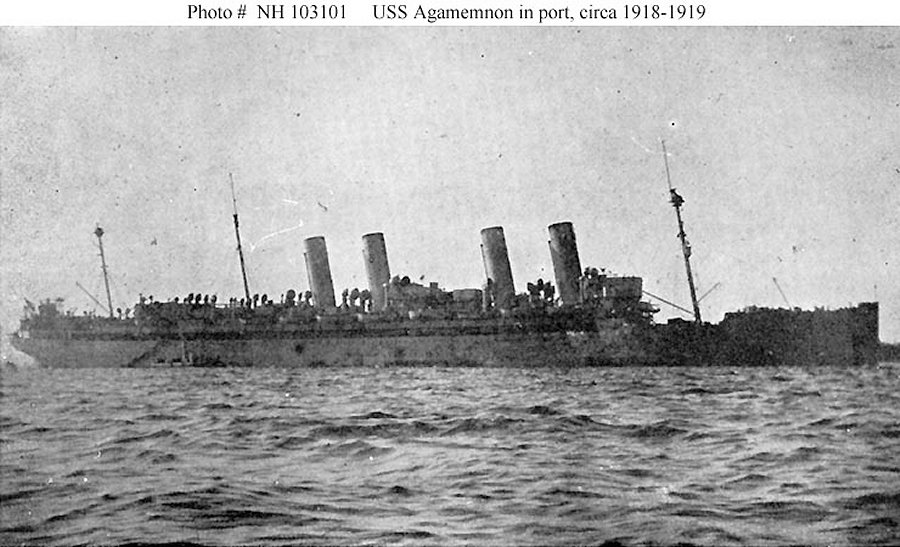
And, finally, here's a photo of the Agamemnon, found here:  Via http://www.navsource.org/archives/12/1217300412.jpg

Halftone reproduction of a photograph taken in 1918-1919, showing the ship in port. Donation of Terri D. Lewis, 2005. Naval Historical Center photo NH 103101
I have written before about my grandfather, Verne Russell, and I hope to write more this year, about him and my other grandfather, Sam Adams, and about my husband's grandfather, Albert Sesma. They all served in the U.S. Army 100 years ago during World War 1. You can read my story about Verne Russell and the letter he wrote to his sister from a hospital in France in December 1918. Here's a link to that post.

Sunday, October 15, 2017

Girls, Pinewood Derby Cars and Awards

Me, as a Camp Fire Girl. Modeling my "ceremonial gown" before an end of the year "Council Fire" where we received our awards and honor beads for the year. We made our own "gown" and decorated them with our earned honor beads, pins, and patches. See below for some detail.
Last week the Boy Scouts announced their plans to “allow” girls to join and earn an Eagle Scout Award. Some of the reaction to the news was expected — the typical complaints about Scouts allowing gays to join “and now they’re inviting girls!” On the other hand, some of the reaction was surprising and irritating. In fact, I was surprised by my irritation with some reactions. So I took a little time to calm down. And then I started writing. Because that's what I do.

It’s not that I care all that much about the Boy Scouts as an organization. I’m not particularly impressed with them these days. I know "letting" girls do Eagle Scout Projects/Awards has been talked about at least since I was a Camp Fire Girl nearly 50 years ago. Given their recent history, the cynic in me sees this news as another attempt to change the narrative around Boy Scouts after recent years of bad press and declining membership. Still, good for them.

My problem, my irritation, is with the comments I’ve seen from women saying they always wanted to be a Boy Scout and participate in a soapbox/pinewood derby and be Eagle Scouts. Some complained about their experiences as a Girl Scout or Camp Fire Girl, claiming they couldn’t do cool stuff as a girl, a Camp Fire Girl or Girl Scout; or that their experience was “lame.” But I know that both of those organizations have always had ways to do whatever activity a girl wanted. So these complaints bothered me. Here’s what I wish I could say to each of them:

“If your experience wasn’t up to your standards or what you thought your experience would have been as a Boy Scout, I’d like to suggest you look to yourself first. What did YOU put into your experience? What did YOU contribute to your group or troop? Were you willing to try new activities and adventures? Were you willing to test yourself? Maybe it wasn’t Girl Scouts or Camp Fire. Maybe it was you. It’s sad and unfortunate if you didn’t have leaders like I had or if you lived someplace not served by Girl Scouts or Camp Fire Girls. If they had known you were there, waiting for them, they would have found a way to reach out to you. I know they work hard to break through all the noise from groups vying for your attention.”

Our fearless leader, Mrs. Haven "retired" so we gave her a silver platter. That's me, kneeling, to her right. We’re all wearing our ceremonial gowns.
I know why I was irritated. I feel like I was born a Camp Fire Girl because my older sister and cousin were members first and my mother was a leader. I became a member under my own name as a Blue Bird and was a Camp Fire Girl all the way through Horizon Club in high school, and then a camp counselor at CFG camp while in college. I was able to accomplish every goal I set for myself as a Camp Fire Girl. In fact, Camp Fire is where I learned to set personal goals. 

OK, here’s the truth. There are goals I did not accomplish. I still can’t sew. But I can build a roaring fire in a fire ring. 

I attended an all-girls high school and belonged to an all-girls organization. (Camp Fire is now co-ed.) I also participated in many other activities that influenced me and helped me develop into the adult I wanted to become. Was it Camp Fire, Junior Theater, or one of my volunteer activities that had the biggest influence? Hard to say. I only know that without Camp Fire, I’d be someone else. We chose “Indian” names for ourselves in Camp Fire that were supposed to describe who we were, or hoped to become. I have my doubts about the authenticity of the “Indian” words I used, but the meaning described the type of person I hoped to be. 
“Wi yo tanda: faithful, understanding, loving, respectful”

Camp Fire Girls can earn the WoHeLo Medalion. (Work Health Love. WoHeLo is used as a greeting, a farewell, and a wish to each other in Camp Fire.) Girl Scouts can earn Silver and Gold Awards. Girls earn these prestigious awards by completing self-designed service projects that are every bit as demanding and important to their communities as any Eagle Project I’ve ever seen. I’d say the work girls do to earn the Camp Fire Wohelo Medalion and Girl Scout Gold Award are equivalent to the work done for the Eagle Scout Award. 

Maybe I should have worked to earn the Wohelo Medalion. I know my work in Camp Fire’s Horizon Club was probably equivalent but I wasn’t interested in awards. Perhaps I’m not the only woman who doesn’t feel the need to claim they are better than others by bragging about being Eagle Scouts. Or perhaps it’s irrelevant — when employers and society in general don’t value the achievements of girls and women. I know there are former Camp Fire Girls or Girl Scouts, with or without Wohelo or Gold Awards, working every day to change the world and make it better. I doubt they continue to list their youthful accomplishments on their adult resumes. I stopped listing mine after my first couple of jobs. Once someone is an adult, I guess I’m less and less impressed by something they did when they were 16. I mean, we should always be proud of our achievements, as I am of mine, but after a while what I did at 16 or 18 doesn’t prove anything about what I can do as an adult.

Perhaps the real problem here is not Boy Scouts, or Camp Fire (which has been co-ed for decades) or Girl Scouts. Perhaps the problem is that our society doesn’t value the achievements of girls like it does the achievements of boys. I’m pretty sure there’s enough boys and girls to fill the ranks of all these organizations. Let’s let these boys and girls all rise to the highest level they desire in the organization they choose, and be recognized by their peers, future educational institutions and employers as EQUALS. This requires a change in our institutions and employers regarding the equal value of achievements by boys and girls when they become men and women. 

Still, good for the Boy Scouts. I hope it works out for them. As for me, I am a proud former Camp Fire Girl whose only achievement was hard work and sticking with a program I loved all the way through until I aged out. I am also a proud mother of three former Girl Scouts, one of whom decided to become a Lifetime Member and is now a troop co-leader while she writes her PhD dissertation. I’m proud of her for mentoring young girls. She’s not an Eagle Scout. She doesn’t have a Gold Award from Girls Scouts. She’s just a former Girl Scout -- correction, Lifetime Member of Girl Scouts  —  paying it forward.

What can I say? It was the late 1960's. Of course I made a peace sign with my Citizenship Honor Beads. We earned honor beads for activities accomplished in various areas. Business, Citizenship, Creative Arts, Frontiers (think science), Home, Outdoors, Sports and Games.
Finally; and by the way. You’re never too old to build a pinewood derby car and maybe start your own derby. Maybe find some young girls to mentor. All that cool stuff you think you missed as a Girl Scout? Go ahead! What’s stopping you?
Or contact your local city or county volunteer offices and find a youth organization that needs you.

WoHeLo,
"Wi yo tanda"

This is my beaded headband that I made myself! I'm wearing it in the above photos. The pictographs were supposed to represent the names we chose for ourselves, but I think mine was just a pattern that I liked and was able follow on the loom. Thunderbird with geometric patterns. I have no record of why I chose the thunderbird or the patterns.
Two of my Camp Fire Books.

Monday, April 17, 2017

"You know, he was gassed during the War." My Grandfather, World War 1, & Mustard Gas


“You know, he was gassed during the War.”


My grandfather, Verne C. Russell.
Undated photo.

I didn’t know much else about my mother’s father when I was growing up. I knew grandfather, Verne Russell and my grandmother, Margaret Henderson Russell, divorced when my mother was young. I know now that the divorce was official in 1932 when my mother was almost 11 years old. My grandmother lived with us when I was that age in the early 1960s, and I suppose we somehow knew he was not a topic to be raised. My parents did take us to visit him a couple of times and I know she exchanged a few letters with him over the years. He died in 1971 at the age of 78. I was 18.

My mother Betty. Her sister, Peg. With Verne and wife, Gladsia.
Peg, Betty, Verne, Gladsia. Labelled on back as early 1940s.
Nearly 50 years after my grandfather's death, it’s hard for me to remember when I learned things about him. A little bit here and little bit there. But generally, I saw him as a sad old guy who never got to fulfill his potential. A partial list of things I knew: 
  • He was gassed during The War. It ruined his eyes. 
  • He saw himself as a Great American Novelist or Newsman but was in fact, not exactly illiterate, but definitely uneducated.
  • He lived in the Ozarks, for goodness sake. His California grandchildren couldn't relate to that.
  • He really blew it when he had an affair. My grandmother was smart to leave him though I suppose she didn’t have much choice.
So, why write about him now? Did something about him change in the 46 years since his death? Of course not. But access to information has changed, thanks to the internet.

Verne C. (Vic) Russell didn’t become a famous author or newsman, but once upon a time, he wrote a letter to his sister and it was published in their local Kansas newspaper. I found it on the internet several years ago and shared it with family and friends. Then I transcribed it in April 2017, nearly 100 years after he wrote it. I was looking for some small tasks to do while flying to and from California for a cousin's memorial a few weeks ago. The action of transcribing the letter seems to have changed everything. 

Of course, coincidentally, PBS has a World War 1 American Experience airing and the Library of Congress has their own WW1 commemoration on their social media to mark the April 2017 100th anniversary of America’s entry into The War. Many of the social media accounts I follow have noted this. So I'm sure my subconscious was primed to think about WW1. 
and here’s a link to Library of Congress WW1 resources in general, https://www.loc.gov/rr/program/bib/wwi/wwi.html)

I’ve worked on family history long enough to know that research changes what you know and what you think about people. Sometimes, it's not new information or records that change things. Sometimes it’s looking at an old record with new eyes or thinking about it in relation to historical events. My own years of genealogy research efforts added to the research done by my mother and her sister after their father died. I knew they had files on him, with records and family tree information on the Russells that they gathered on an epic road trip they took in 1990. But I hadn’t done much with it other than entering names and dates on Ancestry, along with the occasional census or military record received from the National Archives (https://www.archives.gov/veterans). 

I can’t pinpoint what it is that’s changed. I already knew about the letter and Verne’s military record. Maybe it’s the self-effacing way he describes his part in the events he survived during what I know now was major World War 1 battle. Look up October 4, 1918 in France! Look up mustard gas in World War 1! He was lucky. He not only survived with relatively minimal damage to his eyes. He survived and lived to 78 years old. The facts about Verne Russell didn’t change. My understanding of those facts changed.

Over the years and even in 2013 when I shared my “find” we often made jokes about how our grandfather saw himself as the Great American Novelist who just never got the break he thought he deserved. But I know now that he and his second wife Gladsia did publish a few pieces in their local papers and the big-time St. Louis Post Dispatch. They loved their mountain home that they built with their own hands, and even published a multipart series about their decision to leave St. Louis and build their home in the mountains. I have photocopies of the series from my mother's files, but haven't figured out where they were published. These articles show he was a very simple man, but with the help of Gladsia, he wrote and published. There's nothing wrong with being a simple man with roots in Kansas and Arkansas. I feel sad that he never realized his dream and I don't think he was sad about it either. I don't think less of him for that or for his roots. 

I hate that my grandfather had an affair. It's hard for me to respect people who do that. But as is often the case, my grandmother was probably better off without him. It’s a bit ironic that a man who probably saw himself as a strong man, with a CAPITAL M, married two very strong women. One was strong enough to leave him and raise two daughters without him. The other was strong enough to take care of him for 40 years, and try to make him into the man he thought he was. I'm proud to have my grandmother, Margaret Henderson Russell, as my role model of a strong woman.

As a young man, before my grandmother met him, he served his country from 1914 to 1919. He received two Purple Hearts, one for action in July 1918 and the other for the events of October 4, 1918 which are the subject of his letter. So clearly, he was a Strong Man. His military record is impressive for an uneducated man from the middle of America, or for anyone. I'm proud of his service to our country. 

He was handsome in his uniform when my grandmother met him. He had recovered from the gassing. He worked at Fort Leavenworth where both her father and grandfather had been stationed and worked as guards. My grandmother worked there as well as a telephone operator. We'll never know why she fell for him. There must have been something different about him, compared to all the other young men she met. Her scrapbook is full of pictures of her with young soldiers and veterans. She never remarried, but she always had gentleman friends. Her story is for some future blog post, or perhaps a book. 

The Leavenworth War College, where Verne and Margaret met.
In 1918, my grandfather really was “gassed during the war” and he wrote about it to his sister, while recovering in a hospital in France. This letter was surely dictated by my grandfather, perhaps to his nurse Ethel Hofer, perhaps to some other hospital volunteer. His eyes were just beginning to function two months after the gassing he experienced, so I don't think he wrote it by his own hand. But I can hear what I am sure is his voice coming through; for example, when he uses the phrase “dippy as a coon.”


Transcribing this 1918 letter from Verne Russell to his sister brought my grandfather to life for me after years of research. And so as the anniversary of his birth 124 years ago approaches, I honor the grandfather I barely knew. Verne C. Russell, the man who was gassed during The War.

Beaul, France, Dec. 20, 1918
Dear Sister and All:
  This will be a full account of my trip to the hospital. The fatal day was October 4th; time 10:30a.m.; place Argonne Woods; cause mustard gas.
  On the evening of the 3rd I had orders to take three men with me and stay at a switchboard station until the next morning when we would receive orders to move on at the right time.I picked my men and went to the station, those on duty returning to their dugouts. I knew that in the early morning hours we were going to throw a barrage into Jerry and of course the boys were going to follow, the Signal Corps going with the infantry. During the night I found out the barrage was to commence at four o’clock lasting one hour — then over the top.
  About 3:20 I went to the dugout to get my pack but could not roll it until the S.C. got out of the way for I got stepped on a number of times trying it. I gave it up and started to talk to a sergeant. While we were talking the barrage started and as the boys were to follow it up they started to file out. About the time our barrage started Jerry came down with just as good a one so you see we went out into shell fire that is something like going out of a house into a rain storm. I rolled my pack and beat it back to the station for I expected our lines to go out under that hail of shells. But as luck would have it not a line had been hit. Two things I forgot to mention: Early in the evening I had a few words with two officers about moving my station. My officers had told me to stay there but these officers from another outfit wanted the dugout I had the switchboard in for their headquarters, so I called my signal officer and we stayed. They felt sore and I can’t blame them. After the barrage started I made up for the feeling though, for they both got hit, hone in the hand and the other in the neck. I tied them both up in fine shape and they went on to their headquarters. The other things was the dugout where the S.C. stayed was large enough to sleep 150 men though we were somewhat crowded. About 6:30 our line went out but I found the break a short ways from the station. 
  I went back and took the switchboard myself to let the men sleep. I was at the board until  about 10:30 when a line was shot to pieces I found out later. I called the switchboard man, took another man and went to find the break. Jerry was shooting gas so we had to wear masks. We came to a place where the line ran through some bushes and here we located the trouble. After mending it we started back to our station to get a little sleep. I slept four hours when I had to go chase a line. I felt funny and a little sick and when I went out in the air my eyes began to burn and water but I went on. By the time I had the line fixed I had to force myself to keep my eyes open. The sickness had gone to my stomach and I did the seasick act proper. One of the sergeants was there and he took me to the first aid station. The only way I could see by this time was to pull my eyes open. They loaded me into an ambulance and sent me to a field hospital and for three weeks my mind was blank. Sometimes I would come to long enough to get a faint idea of where I was, once on the train, once in the hospital, and once here. In the filed hospital I remember I was sick at the stomach and I heard a voice I thought I knew. On the train was where I was scared and I had a right to be. I came alive and found I was all stopped up, could not get my breath and had a rattling in my throat. I called for a doctor and they carried me to the car ahead where I could get more air. From now on is what the nurse told me. She is Miss Ethel Hofer, of California, and if you want to thank anyone, she is the one. Miss Hofer has told me showed her a good time the first few days, said I was dippy as a coon. After I got my head back again I lay there thinking about my eyes. No one will ever know how much my brain worked those days. I knew the government would teach me some kind of a trade but I sure hated to think about not being able to see again. I asked the doctor if I would ever see again and he always said yes. But I thought differently though I never said so but once. The doctor came and pried my left eye open and I saw just a bit of light. Not long after that my right eye came to life and from that time I have been coming along in very fine shape. My eyes are just about as good as ever and my cough is better although I still cough a plenty. Can’t do much for one of these cough — just have to cough it out.
  Have been expecting to leave here but have decided to wait and let them do as they please. I will be home some time.
CORP. VERNE C. RUSSELL
Co. C, 5th Field Battery, A.E.F.

Clipping from the Iola Daily Register, February 11, 1919.
The "Happenings at Colony" column.

Monday, October 3, 2016

The Sister-Friends Bereavement Society Parade


"You have found a place in my heart, and so that place is yours. It will fly your flag, speak your language, and honor you with festive parades forever." (Leigh Standley, Curly Girl Design.) 

Once upon a time, 20+ years ago, a friend was dying and we went to see her. It was a lovely visit and I left knowing I had told her how much she meant to me. Later, I wrote her a letter, not knowing if she'd ever see it or know I sent it. I needed to know that I hadn't failed to tell her the important place she would always hold in my heart. Then one day, I carried all the groceries up from the garage and Mike was standing in the kitchen with the news he didn't have to say out loud. 

The Sister-Friends Bereavement Society not a fun club. The meetings are unbearable and I’m tired of attending them.

But now, another meeting of the Society will be called to order and I'm a little angry about that. I'm consoling myself with the knowledge that this sister-friend knows how I feel about her. Because I told her. And then I told her again. And she thanked me. This summer, I joked that I had no unfinished business with her — well, except for the unplayed mah jongg games and the Cosmos we wouldn't drink together. 


Don't get me wrong, this going to be horrible. It always is. I will miss her with a searing sadness. But I will attempt to honor her wishes (“Don’t cry!”) and try to honor her with festive parades instead of tears.


Artwork & words © 2011 Leigh Standley, Curly Girl Design Inc.
www.curlygirldesign.com
(A card I gave to my friend last week.)

Sunday, September 11, 2016

Regarding 9/11/2001. Choosing Hope and Love.

Regarding 9/11/2001. Written on 9/11/2011. Posted on 9/11/2016

[A friend sent an email to her friends, asking for their 9/11 memories. I decided to go ahead and share something I wrote for myself in 2011.]

I was in my cubicle at work at Aspen. Suddenly, I hear Stephanie arriving and she’s saying she just heard on her car radio that a plane had hit the World Trade Center. Like many others, I imagined a small private plane, but she said no it was a commercial airliner. Next I remember several of us standing around wondering what happened. Then someone said another plane had hit the other tower and then I knew it was not an accident and this was what we all came to know as the attack on the WTC. 

In those first minutes, my first thoughts were of my sister, Susan, who lived in Jersey City but whose office was just blocks away from the WTC. Then I remembered, oh wait, she’s not there. She died in February. 

But what about her husband Francois and her colleagues who worked there as well? Then there was Mike’s brother Thom, and Nancy and Jillian who lived in NYC. For some reason though, I wasn’t too worried about them, because in my mind’s eye I pictured them far enough north to not be in immediate danger. Of course, I learned later that they spent the morning scrambling to get Jillian from her school.

I remember standing at my computer trying to get on line to a news site. I went to the conference room and turned on the tv and tried to tune it to a news channel. I actually moved the tv cart around trying to find a spot where we could get some reception. I remembered my emergency radio and took it up to the front desk so that Brenda could listen for news.

People were starting to hear from family members who were trying to leave their workplaces in DC because by now a plane had crashed into the Pentagon and there were reports of a fourth plane coming towards DC. Of course, we later learned that plane would crash in Pennsylvania.

At some point I heard from Mike who was at work, and from Jennifer who was at home. She had just arrived the day before after driving down from Boston—on her way to California after graduating from college. She was upset and trying to convince Mike that he should leave work since he worked in a government building. He finally got word that they could leave. I wasn’t sure where Shanksville was, but thought it was far enough away from Amelia at Penn State that I felt she was safe. I don’t remember when I talked to her. I just remember knowing she was OK.

I’m not sure now, why I didn’t get hysterical and rush to pick up Elena at school. Someone asked me and it didn’t make sense to me—I figured she was safe, right where she was. I finally went home so I could be there when the kids got off the bus. I remember when Kim and Elena came up the street, I was worried about Kim going home to an empty house because I wasn’t sure Sandy and Sam had been able to leave work. She said she’d come back up if no one was home. 

I went next door to the Ritterpusch’s to check on them because John and Lynn were in Hawaii at a convention. Of course, their grandparents were already there. It would take days for John and Lynn to get on a plane and make their way home.

We spent the rest of day watching tv and listening to the news on NPR and trying to NOT upset each other, and especially Elena. By evening we had been able to check in with family and knew that Amelia was fine at Penn State, Francois was fine, that Thom, Nancy and Jillian were fine, and that the rest of the family was OK.

Looking back, it seems like those next days all merged together. I don’t remember much except watching the tv and checking in with people. My niece, Jama was supposed to have arrived here from Los Angeles on the 11th and was stuck in LA. Her boyfriend had arrived on the 10th and was staying in a tiny basement room in northern VA. We went and picked him up on the 14th, thinking he shouldn’t be alone and was safer here in Gaithersburg. Jennifer’s friend from Boston finally made it here, and the two of them continued their post-college-adventure-road-trip out to California. They left here on the 18th. Jama arrived from California and she and Brian stayed here until they found an apartment. They were both starting jobs on The Hill and have spent the last 10 years living in DC and NYC. Jennifer made it to LA on the 26th. Elena had her meniscus repair surgery on the 28th. 

Our lives went on. All of us went on, but we were the lucky ones. Our hearts were broken and we were scared. But we didn’t have gigantic holes in our lives where loved ones once stood.


I won’t go into my feelings about everything that’s happened since 9/11/01. And I won’t presume to tell you how you should feel. I’ll just say that I refuse to give in to hate---even after so many people have tried to get me to hate others, and after all the opportunities I had to hate. I will always choose Hope and Love.
9/11/2016

Thursday, July 28, 2016

The Story You Are About to Hear


Once upon a time, 

I planned to go to grad school and law school and be a clinical psychologist with a law degree and help people. 

But then, Life. 

Also Grades. Also GRE scores.

And so I joined the ranks of working mothers, doing (to quote a favorite singer/songwriter John Stewart) “the best they could” and doing it “pretty up and walking good.” (John Stewart, "Mother Country")

And when John Hinckley shot a President and three other people and then got off on the insanity defense, I thought, well I sure am glad I won’t ever be asked to defend a client like that.

Today’s news has reminded me about all of that. And it reminded me of how, over the years, I have offered my thoughts and prayers to all the people who have had to spend their careers watching over this guy, and for the families of the four victims, and felt bad for the people who live at his mother’s residence who have to see him every day during his visits.

The other part of my initial reaction was to wonder WTH this judge was thinking?? I do not understand how he came to this decision (even with all the restrictions on JH). Then I happened to see someone claiming “of course he’s a Clinton appointee” so that explains it. Huh? I’m pretty sure that if we were a “Clinton supporter” as well as appointee, he would not have chosen this day for his decision. Optics and all that. No, I think he’s just another judge, sitting in his chambers, reviewing all the arguments and making a decision with no clue about the calendar.

Apparently, he’s done some “good work” in his career - including seeking to reverse a previous bad decision. This does not feel like a “good work” to me.

I’m not even a fan of Reagan or most of his family. But this creep shot not only a president, but three others. This release order might be legally OK. But it just doesn’t feel morally OK.

Thoughts and prayers to all remaining Reagan family members; to the James Brady family and to the two surviving victims Thomas Delahanty and Timothy J. McCarthy; and to all our civil servants who have to spend their time watching over this creep and making sure he follows the rules and stays on his drugs.

For me it’s another sad day in gun history, mental health care, and for the legal system. 


Here's my overused thought that I'm tired of posting.

Sunday, August 30, 2015

The Best Guilt Trip Ever. Or How I Saw The Beatles at the Hollywood Bowl and Learned to Forgive My Dad

“I guess I put away my Beatle records one day and never really knew why. I wonder if it was because I was afraid to feel so strongly about anything?”
That’s what I wrote when George Harrison died in 2001. I took out the old records and listened for hours while I cried. I was taken aback by the support and hugs from my daughters. I didn’t know they understood. 

I was pregnant with Amelia when John Lennon died in 1980. We lived in California where Mike was in grad school working on his dissertation research. He was at the lab, as usual. When he finally came home, he found me sitting in the rocking chair. I think I was in shock. In my memory, I was sitting there rocking 18 month old Jennifer, waiting for him to come home and help me make sense of it.

Fifteen years before that, on August 30, 1965, I experienced The Beatles at the Hollywood Bowl with my best friends Kathy and Nancy. I was 12. They were 14.  In my Beatles scrapbook, I wrote that it was the “Happiest Day in My Life. (so far)” 
For fifty years now, I’ve bragged about that concert as a “claim to fame” whenever someone would mention some concert they attended, or famous person they met. When my girls were young, it was a way to show them how cool I was. They could never top that crowning achievement of my life. No one could.

It still is a highlight of my life. Just a moment in time, really. But the truth is, it was the culmination of a long hot summer, in a year filled with events that changed the world, not just my corner of it. So many of the events of 1965 changed our country and our lives — just search for  “1965” on the internet and you’ll see a long list of important events. A look at the events of August is like looking at a snapshot of the types of things that happened all year.
  • August 6. President Johnson signed the Voting Rights Act of 1965 into law. 
  • August 10. The Housing and Urban Development Act of 1965 became law. 
  • August 11 - 17. The so-called “Watts Riots” took place in South Central Los Angeles, about 10 miles from my driveway where I stood and watched the smoke from the fires as several hundred buildings burned. On the 11th, police stopped and arrested a Black man for drunk driving and then proceeded to arrest people, including family members, who had gathered to find out what happened. 14,000 National Guard joined the local police to “restore order” and enforce a curfew which was finally lifted on August 17. 600 buildings were damaged by burning and looting and another 200 destroyed. As a 12-year-old, I wasn’t sure how far away we were. It looked like a couple blocks from my perspective. I wasn’t personally scared, but I felt like I should be because all the adults I knew were concerned and the nightly news was full of pretty scary reports.
  • August 18. 5,500 U.S. Marines destroyed a Viet Cong stronghold in “Operation Starlite.” American involvement in Vietnam escalated throughout the year with 125,000 American military present in July. Monthly draft calls had increased to 35,000. Draft card burning had also increased as anti-war protests increased and on August 31 Johnson signed a law criminalizing draft card burning. Entire books have been written about American involvement in Vietnam so I won’t try to give that history here.
  • August 21. Gemini 5 launched for a record 8-day space flight.
  • August 23-30. The Beatles, on a U.S. tour starting the 14th, spent a week getting some R&R in a rented Beverly Hills home before their two Hollywood Bowl concerts on August 29 and 30.
  • August 30. The California Angels lost to the New York Yankees at Dodger Stadium. (Not everyone in Los Angeles cared about the Beatles on August 30!)
1965 was my last summer in my childhood home. My Dad was transferred to San Diego to open a new regional office of Union Bank. This came with a new title, Regional Vice-President. There was no discussion. He informed us sometime at the end of the 64-65 school year. I remember telling my school friends that we were moving, and they didn’t believe me! Westchester was a very small town and after school ended, my world shrank even further to just the places I could walk to within a few blocks, such as the local playground and public swimming pool.

Kathy lived across the street. Nancy lived on the next block, but her house backed up to our next-door neighbor and we always climbed that fence rather than walk all the way ‘round. Dede, also older than me, lived across the street next to Kathy, and was a member of our informal Beatles fan club. But she had polio as a child and had only recently become strong enough to sit up in a wheelchair. We spent hours over at Dede’s house after school, talking about the Beatles, listening to them on the radio, looking at Beatles fan magazines, trading Beatles trading cards, and discussing which Beatle was our favorite and which one we would marry!

Then we heard the announcement that the Beatles were coming to the Hollywood Bowl, with information about how to send off for tickets. No internet. No Ticketmaster. The organizers were trying to avoid the previous year’s problems with tickets by having people send in requests for tickets with their money, instead of lining up for hours at the Hollywood Bowl. 
Ticket order form. From the KRLA Beat May 12, 1965. (http://krlabeat.sakionline.net/issue/12may65.pdf)
But first, we had to convince our parents. I don’t know what tactic Kathy and Nancy used, but I went straight for the guilt trip with my Dad — because of course Mom said “Ask your Dad.” My argument was something like this: 
You’re making me move away from the only home I’ve ever known and the only friends I’ll ever have and this will be my only chance to ever see the Beatles.
I have a mental image of cornering him in the living room and giving what I thought was a well prepared speech. I felt like I couldn’t shut up and I went on and on. I had answers to his every question. What a performance! I think I wore him out and he finally relented. I wrote in my scrapbook 
“Dad finally agreed to let me go see the Beatles in August. Nancy Anderson, Kathy Kuhl and I are going together if we get the tickets. We had to send to the Hollywood Bowl. We’re hoping for seven dollar tickets.”
I don’t remember who gathered the money and sent off our request, but somehow we did get tickets back in the mail. 
$6.00 tickets!! Section F, Row 15!!
Now for the logistics. We weren’t old enough to drive so one of the parents would have to drive and we would go the day before and have a practice run. A little rehearsal to make sure we knew where our seats were and where we would meet after the show. We agreed to every restriction the parents thought up. We were so afraid one of the parents would decide we couldn’t go. Parents are so unpredictable!

Finally the day arrived. We all wore dresses or skirts which was considered appropriate concert attire. I don’t remember the drive from Westchester to the Hollywood Bowl. It’s a 30-40 minute drive I guess. We got dropped off and made our way to our seats and just sat there waiting and watching the crowd. (At some point there was a buzz as five guys with long hair walked up the steps to our far left. Everyone speculated that it was “The Byrds” but I’ve never been able to confirm that. Why would they be out in the general audience instead of backstage hanging out? Maybe that didn’t happen in those days? And I suppose there wasn't much hanging out backstage because the Beatles arrived and departed in a Brinks truck. I think they did their hanging out at the Beverly Hills/Benedict Canyon mansion they had rented. Anyway, all the VIPs were seated right in front of the stage, not at the top of the amphitheater, even higher up than where we sat.)

I’ve read that there were opening and closing acts at the show, but I have no recollection about them. I do have the Beatles set list. The comment at the bottom is my handwriting. I'm not sure if Kathy or Nancy wrote the list.
When you read about Beatles concerts, it’s always said that the screaming was so loud you couldn’t hear the music. That wasn’t true for us. We heard all the music. We heard the chatter among the Beatles (not that there was much). We could even hear each other. I’m not saying it wasn’t loud. It was! We had to shout to be heard by each other. We also did our own share of screaming - enough, that we all had “party girl” voices at the end. But I’ve always felt like we were pretty subdued compared to the other 17,000++ fans surrounding us. However, maybe that was just me. I’m the one who left with a deep indent in my forearm where Nancy grabbed me during at least one song, and left the imprint of her fingernails.

And then. . .
“They were here and too soon they were gone. It was really exciting! Something I’ll never forget! They sang 12 songs. I love them! They're fab, fab!”
I’m not sure how long we sat there at the end of the show. Somehow we made our way to the pre-selected pick-up spot. We must have stopped to buy programs because this program is also in my scrapbook.
The next thing I remember, I was in San Diego (La Jolla, to be precise) starting 7th grade. My older sister stayed behind in Los Angeles to finish her senior year of high school. We made many weekend trips back and forth because it took months for our house to sell. Mom would pack up the station wagon; we’d drive north; camp out at the Westchester house; then drive back on Sunday night. I don’t even know why we did that. Maybe Mom needed to do some work on the house. Maybe she just needed to see Sue. I tried to hang out with old friends but I know I felt very alone. Kathy, Nancy and Dede were busy with high school activities and my own former classmates seemed uninterested. 

The house finally sold so we didn’t go as often but none of us had made many friends in La Jolla. Our La Jolla rental house was near the top of “Mt Soledad” and we were very isolated and dependent on rides to go anywhere. My social life consisted of babysitting, attending confirmation classes with people I didn’t know, and watching endless hours of afternoon TV with my siblings.

Even Christmas was a sad occasion because we all had the flu. What a pathetic bunch we were, sprawled around the living room, taking turns opening gifts and trying to be happy. And then, I opened a gift from my mother. This woman who never showed emotion and didn’t seem to understand a 12-year-old girl, gave me “Rubber Soul” which had recently been released. I don’t know how she knew the Beatles had a new album! (see my story about Rubber Soul here. http://honeylights.blogspot.com/2014/12/rubber-soul-49-years-ago.html) I don’t know how she found a way to deal with the needs of five struggling kids when she was struggling with her own needs!

Somehow we all survived 1965. However I think we all became different people than we would have if we had stayed in Westchester. The old neighborhood no longer exists. The streets and sidewalks can still be seen from the air, but it’s surrounded by a huge wall that was built by Los Angeles International Airport after they bought the land. We moved to another rental house in the summer of 1966 and Sue came home to attend the nearby University of California at San Diego. We all carried on our lives, going to school, joining clubs, playing sports, attending church — and listening to Dad and Sue argue about Vietnam every night around the dinner table. The “Betty Crocker Homemaker of the Year” had become “radicalized” you might say. Dad probably regretted making her stay home to attend UCSD instead of letting her go to Santa Clara with the Jesuits! 

Looking back 50 years, it seems clear that 1965 was a turning point for our family and maybe for the world. Even the Beatles were changing in 1965! I know I’m not the only person for whom personal and world events are inseparable from the music playing in the background. The music of the late 60’s and early 70’s is regularly invoked and played as background music when discussing this time period; especially when talking about Vietnam.

There were times I felt like my parents had ruined all of our lives by moving to La Jolla, but then I remember August 30, 1965. I’m not sure I would have that memory if I hadn’t been able to guilt-trip my Dad into letting me send off for tickets. He probably figured there was no way we’d get them, but we did! And so in the end, I had to forgive him for ruining my life and be grateful that he let his 12-year-old daughter have the happiest day in her life.
Me in 1965.